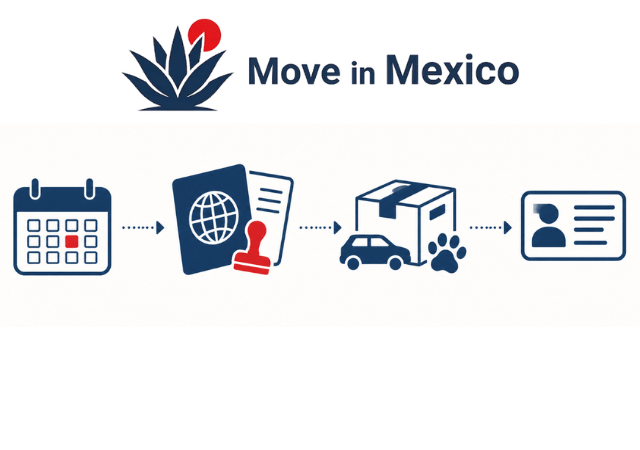
How to Move to Mexico from USA in 2026: Complete Step-by-Step Guide
Approximately 1.6 million US citizens currently live in Mexico per State Department estimates (Mexico’s own 2020 census reported a lower 797,000), making Mexico by far the largest American expat destination globally. The reasons are obvious: warm climate, low cost of living (40-60% below US), proximity (you can drive or fly home in hours), excellent private healthcare in major cities, and a well-documented immigration pathway that’s faster and cheaper than European alternatives.
Updated October 2026
By Bruno Bianchi, CEO of Spainguru (225,000+ community members) · Updated October 2026
Key takeaways
- Most Americans follow the same ten steps: visit first, pick the city, choose the visa (tourist FMM under six months, TRV for one to four years, PRV), apostille the documents, prove solvency at a consulate in the U.S., then enter Mexico and complete the INM canje within 30 days.
- For 2026 the TRV asks for roughly $4,500/month of net income for six months (consulates publish ~$4,300–4,800) or ~$76,000–80,000 in savings; the PRV roughly $7,650–8,000/month or ~$307,000–320,000 and is generally reserved for retirees — figures are set in UMAs, change every year and vary by consulate.
- After the card come the CURP, the RFC at SAT, a Mexican bank account, IMSS or private insurance and, if you drove down, the TIP decision before your status changes.
- Plan three to nine months end to end: the apostilles and the six- or twelve-month financial look-back are the slow parts, not the consulate itself.
On this page
- TL;DR — the 10-step path most Americans take
- Step 1: Decide if Mexico is right for you
- Step 2: Choose your destination city
- Step 3: Choose your visa type
- Step 4: Apply at Mexican consulate in US
- Step 5: Set up US banking before moving
- Step 6: Plan healthcare strategy
- Step 7: Plan household goods move
- Step 8: Arrive in Mexico and register at INM
- Step 9: Set up local life
- Step 10: Manage ongoing US tax compliance
- Costs — what to actually budget for the move
- Disclaimer
This guide walks you through every step of moving from the US to Mexico in 2026 — from initial decision to first year settled — including the unexpected gotchas most “moving to Mexico” articles skip.
TL;DR — the 10-step path most Americans take
- Visit Mexico at least once for 2-4 weeks before committing
- Choose your destination city based on climate, healthcare, expat density, lifestyle priorities
- Pick your visa type — Tourist FMM (under 6 months), Temporary Resident (1-4 years), or Permanent Resident
- Apply at Mexican consulate in US for chosen visa
- Set up US bank/expat banking before moving
- Plan international healthcare strategy — Mexican private + international supplement
- Move household goods (drive or ship)
- Arrive in Mexico, register at INM within 30 days
- Set up local life — Mexican bank, CURP, IMSS, utilities, lease
- Manage US tax compliance annually thereafter
Total realistic timeline: 3-9 months from “I’m seriously committing” to “I’m settled in Mexico.” Many Americans complete the move faster than European alternatives because Mexico’s process is well-documented and efficient.
Step 1: Decide if Mexico is right for you
Before logistics, three honest questions:
1. Are you prepared for cultural and pace differences?
Mexico operates differently from the US in ways that delight some Americans and frustrate others:
- Pace: Things take longer. Bureaucracy is slow. Customer service has different expectations.
- Spanish: Outside major expat hubs, Spanish significantly improves quality of life. In cities like Mérida, Mexico City, Oaxaca, expect to use Spanish daily.
- Family-centered culture: Sundays often family-focused; many businesses closed.
- Personal relationships matter: Networking and trust matter more than US transactional norms.
2. Will you handle Mexico’s safety landscape responsibly?
Mexico’s safety varies enormously by region. Popular American expat destinations (Mérida, San Miguel de Allende, Lake Chapala, Puerto Vallarta, Mazatlán) have generally low violent-crime rates affecting expats. But:
- Mexico has high overall crime rates, especially in cartel-affected regions
- US State Department advisories vary by state — check current advisories
- Personal safety practices (situational awareness, avoid certain areas, don’t display wealth) matter
3. Are you OK with being a long-term expat?
Mexico becomes home for some Americans within months. For others, the “tourist excitement” wears off after 1-2 years and homesickness or cultural mismatch sets in. Visit multiple times before committing; spend at least 30 days in your target city before signing a lease.
If you’ve answered honestly and remain committed — keep reading.
Partners pay Moveinmexico a listing fee or a commission when you sign up. Your price never changes and our recommendations are independent. How we choose partners
Apostilles for your consulate appointment
Monument Visa handles FBI background checks, birth and marriage certificates and pension letters end to end — federal and state apostilles, delivered to your door, inside the validity window Mexican consulates expect.
Step 2: Choose your destination city
Mexico’s diversity means city choice dramatically affects your experience.
Most popular American expat destinations in 2026
Mérida (Yucatán) — Safest. Hot/humid summers. Growing American community. Colonial charm. San Miguel de Allende — Established expat community. Mild year-round. Most expensive. Lake Chapala / Ajijic — Largest American expat community. Mild year-round. Affordable. Puerto Vallarta — Beach lifestyle. Established expat scene. LGBTQ+-friendly. Mazatlán — Beach, more affordable than PV. Smaller American community. Mexico City (CDMX) — Cosmopolitan, world-class healthcare, best public transit. Oaxaca City — Cultural / foodie focus. Smaller expat community. Playa del Carmen / Tulum — Digital nomad / beach lifestyle.
See: Best Places to Retire in Mexico for detailed comparison.
Key decision dimensions:
- Climate: Year-round mild (San Miguel, Mexico City) vs hot (Yucatán, Algarve coasts) vs subtropical (Madeira-style mild)
- Healthcare: Best in CDMX/Guadalajara (via Lake Chapala); decent in Mérida; weaker in Oaxaca/Mazatlán
- Cost: Lowest in Mérida/Lake Chapala/Oaxaca; highest in San Miguel/CDMX
- Expat density: Largest in Lake Chapala/San Miguel; growing in Mérida; smaller in Oaxaca
Step 3: Choose your visa type
Three main options for Americans:
Option A: Tourist FMM (under 6 months)
US citizens can enter Mexico on a tourist FMM (Forma Migratoria Múltiple) for up to 180 days without a visa.
Pros: No visa application required; instant Cons: Cannot legally have long-term lease, can’t open Mexican bank, can’t import duty-free, must leave at 180 days
Best for: Trying Mexico for 1-6 months before committing.
Option B: Temporary Resident Visa (TRV) — most common
Apply at Mexican consulate in US; valid 1 year initially, renewable up to 4 years. Income basis (2026): ~$4,500/month USD net recurring income (consulates publish ~$4,300–4,800) for a single applicant (varies +/- 5–10% by consulate; up to $4,500). Savings-only path: ~$76,000–80,000 (12-month average balance). This is a major increase from prior years following the July 2025 UMA-based rule change — older articles citing $2,500/month are out of date.
Pros: Legal residency 1-4 years; full Mexican services access; can leave/re-enter Cons: Must apply at consulate in US; income proof required; INM registration in Mexico
Best for: Most Americans planning 1+ year in Mexico.
See: Mexico Temporary Resident Visa Complete Guide.
Option C: Permanent Resident Visa
Available after 4 years on TRV, OR directly with higher savings (~$307,000–320,000 USD), OR via family ties.
Pros: Indefinite (no renewal); employment authorization included; cannot easily be revoked Cons: Higher savings threshold for direct path; better as second-step after TRV
Best for: Long-term commitment to Mexico.
Step 4: Apply at Mexican consulate in US
For TRV (most common):
- Schedule appointment at Mexican consulate in your US jurisdiction via the MEXITEL booking portal at citas.sre.gob.mx
- Gather documents: Passport, application form, income proof (6+ months bank statements), photos, visa fee
- Attend appointment: 30-60 minutes, brief interview
- Receive visa sticker in passport — valid 180 days for entry into Mexico
Tips:
- Wait times vary — Denver, Indianapolis, Las Vegas often have shorter waits than Houston, LA, NYC
- Some Americans deliberately use less-busy consulates
- Income consistency matters — stable monthly deposits read better than variable
[Detailed application process: see Mexico TRV Guide]
Step 5: Set up US banking before moving
Don’t close US bank accounts before leaving. Maintain at least one US bank for:
- IRS refund deposits
- Social Security deposits (if applicable)
- US bill payments (insurance, taxes)
- Emergency US fallback
Best US bank for expats: Charles Schwab International — no foreign transaction fees, ATM fees reimbursed worldwide, expat-tolerant.
Open before moving while you’re still in the US (Schwab requires US presence to open).
Add to setup:
- Wise account (multi-currency transfers)
- Revolut account (daily spending)
- Notify existing US banks of foreign address (or risk account closure)
See: Expat Banking 2026 Guide.
Step 6: Plan healthcare strategy
Mexican private healthcare in major cities is excellent and affordable. Most American expats use a combo:
Mexican private insurance ($100-$300/month per couple) — primary care, specialists, hospitalization in Mexico International insurance ($300-$700/month per couple) — emergencies, US visits home, repatriation
Top Mexican insurers: GNP Salud, AXA México, MetLife México, BBVA Bancomer Salud Top international insurers for Mexico-based Americans: Cigna Global, GeoBlue, Allianz Care
For US Medicare considerations: Original Medicare provides essentially zero coverage in Mexico. Some Medigap plans cover up to $50K of foreign emergency for first 60 days of trips. Most American retirees in Mexico drop or suspend Medicare Part B and rely on Mexican + international insurance.
See: Health Insurance for Americans Living Abroad.
Step 7: Plan household goods move
Three options:
Option A: Drive your possessions
Most flexible. Many Americans rent a U-Haul or use their own vehicle to drive household goods to Mexico.
Logistics:
- Pack carefully — list everything for Mexican customs
- Cross at major commercial border crossings (Laredo, McAllen, El Paso)
- Apply for “menaje de casa” import permit through Mexican consulate before crossing — this allows duty-free import of household goods for new residents (rules vary slightly by consulate; check the specific consulate’s checklist)
- Drive 2-5 days to your destination
- Return to US (rental return, etc.)
Time: 1-3 weeks total Cost: $1,500-$5,000 depending on vehicle/rental + fuel + lodging
Option B: Ship via mover
International moving companies (Sirelo, Allied International, etc.) handle door-to-door. More expensive but no driving.
Time: 4-12 weeks Cost: $4,000-$15,000+ depending on volume
Option C: Move minimal — buy local
Many Americans bring only essentials in luggage and replace household goods in Mexico. Furniture, dishes, electronics are all available at reasonable prices. Saves moving costs but requires reset budget.
Cost: $5,000-$20,000 to furnish full new household in Mexico
Bringing your car
Mexican rules on importing US-plated vehicles are complex:
- Tourist FMM: Can drive US-plated car for duration of tourist stay (180 days max)
- Temporary Resident: Can drive US-plated car only with TIP (Temporary Import Permit) — and TIP isn’t available for cars owned by Permanent Residents
- Permanent Resident: Generally cannot drive US-plated cars in Mexico (with exceptions); must use Mexican-plated vehicle
Most Americans buy a Mexican-plated car after settling, sell their US car before moving, or transition through TIP arrangements during TRV phase.
Verify current TIP and vehicle import rules at sat.gob.mx and aduanas.gob.mx before relying on this — Mexico has tightened TIP enforcement in recent years, particularly around Permanent Resident status.
Step 8: Arrive in Mexico and register at INM
Within 180 days of TRV visa issue, fly or drive to Mexico. At point of entry:
- Tell immigration officer you’re entering on Residente Temporal visa (NOT tourist)
- Get canje stamp in passport (30 days to register at INM)
- Travel to your Mexican destination
Within 30 days of entry: Register at INM
- Schedule INM appointment in your Mexican city via inm.gob.mx
- Gather documents: passport, canje document, Mexican proof of address (lease/utility/sworn statement), photos, fee
- Attend appointment: biometrics taken, fee paid
- Receive comprobante (receipt) confirming application
- Pickup residency card 1-4 weeks later
The card is valid for the period requested (1, 2, 3, or 4 years).
Step 9: Set up local life
After residency card in hand:
CURP (Mexican tax ID)
Apply for CURP at SAT (Servicio de Administración Tributaria) office or online. Required for:
- Opening Mexican bank account
- IMSS healthcare enrollment
- Some property purchases
- Mexican tax filings
Mexican bank account
Visit BBVA Bancomer, Santander México, HSBC México, or other major bank with passport, residency card, CURP, proof of address. Open a basic checking account.
IMSS healthcare (optional)
Apply for voluntary IMSS enrollment for public healthcare access. Annual fees ~$300-$700/person depending on age in 2026 (IMSS publishes the schedule each January; rates have been climbing). Many expats also keep Mexican private insurance for faster specialist access.
Utilities
Set up: electricity (CFE), water (local utility), internet, gas. Most utilities require Mexican bank for direct debit. Pay first month at office; subsequent months auto-deduct.
Lease
If you didn’t pre-arrange housing, find a long-term rental. Spanish-language listings on Lamudi, Inmuebles24; English-language services available in expat-heavy cities. Typical lease: 12 months, 1-month deposit, 1-month advance.
Driver’s license
US driver’s license is generally accepted for tourist stays. Once you have Mexican residency, rules vary by state; some states allow continued use of US license, others require conversion to a Mexican license within several months. Convert to Mexican license at your state’s vehicle registration office (no exam required in most states for valid US license holders).
Cell phone
Telcel is largest network. Buy SIM at any Telcel store with passport/residency card. ~$10-$30/month for plenty of data.
Step 10: Manage ongoing US tax compliance
This is the most-underestimated ongoing requirement. As a US citizen abroad, you must:
- File US Form 1040 annually (regardless of income, residency, or whether you owe US tax)
- File FBAR (FinCEN 114) annually if foreign accounts exceed $10K aggregate
- File Form 8938 (FATCA) annually if foreign financial assets exceed thresholds (in 2026, single filer abroad: $200K end-of-year / $300K any time during year; MFJ abroad: $400K / $600K)
- Manage state tax depending on prior US state (FL/TX/NV easy; CA/NY/VA may continue pursuing former residents)
Most Americans use a US expat tax preparer ($500-$1,500/year). See: Best US Expat Tax Services.
Tax-relevant decisions:
- Use FEIE or FTC? (See: FTC vs FEIE Guide)
- Mexican tax residency (home or centre of vital interests in Mexico)? Coordinate with Mexican tax preparer
- IRA/Roth contribution eligibility under FEIE rules
Costs — what to actually budget for the move
| Expense | Typical 2026 cost (USD) |
|---|---|
| TRV visa application + INM card | $400–$800 |
| Optional immigration lawyer | $500–$2,500 |
| FBI background check (apostilled) | $50–$150 |
| Document apostille | $10–$50/document |
| Apartment search trip (if needed) | $1,500–$3,000 |
| Lease deposit + first month rent | $700–$3,000 |
| US-to-Mexico move (drive + truck) | $1,500–$5,000 |
| OR international moving company | $4,000–$15,000+ |
| OR replace household in Mexico | $5,000–$20,000 |
| Mexican bank opening + initial deposit | $250–$500 |
| Mexican utilities setup | $200–$500 |
| Mexican private health insurance (annual) | $1,200–$3,600 |
| First-3-months living expenses | $7,500–$15,000 |
| US-Mexico flights (initial trip + return) | $400–$1,500 |
| Pet relocation (if applicable) | $500–$1,500 |
| Cell phone activation | $30–$50 |
| Total realistic move budget | $15,000–$45,000 |
The wide range reflects (a) move-style choice (drive vs ship vs replace), (b) destination (CDMX more expensive than Mérida), (c) family size, (d) lifestyle.
Frequently asked questions
How do I move to Mexico from the USA?
Get a Mexican visa (Tourist FMM under 6 months, or Temporary Resident Visa for 1-4 years), apply at Mexican consulate in the US, gather documents and apostille what’s needed, set up US/expat banking, plan healthcare, decide how to move household goods (drive, ship, or replace), arrive in Mexico, register at INM within 30 days, set up local life (Mexican bank, CURP, utilities, lease), and manage ongoing US tax compliance. Total realistic timeline 3-9 months.
Do I need a visa to live in Mexico as an American? For stays under 6 months, US citizens can enter Mexico on a tourist FMM without applying for a visa. For stays beyond 6 months or to legally have Mexican bank accounts, leases, and full services, you need Temporary Resident Visa (TRV) or Permanent Resident Visa.
How much does it cost to move to Mexico from the USA? Realistic budget: $15,000-$45,000 covering visa fees, document preparation, household move (drive vs ship vs replace), apartment deposit, first-3-months living, Mexican setup costs, and US-Mexico travel. Lower end if you drive your own goods and replace minimal; higher end if you ship household and rent in expensive areas.
Is Mexico safe for Americans? Safety varies by region. Popular American expat destinations (Mérida, San Miguel de Allende, Lake Chapala, Puerto Vallarta, Mazatlán) have generally low violent-crime rates affecting expats. Always check current US State Department advisories before committing. Personal safety practices (situational awareness) matter.
How long does the Mexico TRV process take? US consulate processing typically 4-8 weeks from appointment. Then you have 180 days from visa issue to enter Mexico, and 30 days from entry to register at INM. Total timeline: 3-5 months from application to residency card in hand.
Can I bring my US car to Mexico? Mexican rules on US-plated vehicles are complex. Tourist FMM holders can drive US car during tourist stay. TRV holders can use Temporary Import Permit (TIP). Permanent Residents generally cannot drive US-plated cars. Most Americans buy Mexican-plated vehicle after settling.
How do I open a Mexican bank account? Visit BBVA Bancomer, Santander México, or HSBC México with passport, residency card, CURP (Mexican tax ID), and proof of Mexican address. Initial deposit typically $100-$500. Some banks have moved to more restrictive policies for non-residents; tourist FMM holders generally cannot open accounts.
What’s the cheapest way to move household goods to Mexico? Driving your own goods in a U-Haul is usually cheapest ($1,500-$5,000 total). Most expensive: international moving company ($4,000-$15,000+). Many Americans bring only essentials in luggage and replace household goods in Mexico ($5,000-$20,000 to furnish full home), avoiding moving costs entirely.
Will I lose my US Medicare? Medicare provides essentially zero coverage in Mexico. You can drop or suspend Medicare Part B (saves premium) but face late-enrollment penalties if you return to US. Most American retirees in Mexico maintain Medicare Part A (free) and drop Part B, relying on Mexican + international insurance. Get specific advice before changing Medicare.
How do I keep my US driver’s license? US driver’s licenses don’t expire when you move abroad. Most US states allow renewal by mail or online. Maintain a US address (P.O. box or family member’s address) for renewal documentation. Mexican driver’s license rules vary by state — some Mexican states require residents to convert to a state-issued license within months of receiving residency; others continue accepting the US license. Apply at your Mexican state’s vehicle registration office.
Disclaimer
Mexican immigration regulations and US-Mexico import rules change periodically. Always verify current requirements with the Mexican consulate handling your jurisdiction and a Mexican immigration attorney for complex situations. This guide is informational, not legal, immigration, or tax advice.
Related guides
Cost of Living in Mexico
Read the guide →Best Places to Retire in Mexico
Read the guide →Mexico Temporary Resident Visa Guide
Read the guide →Mexico for Digital Nomads
Read the guide →Mexico vs USA Cost of Living
Read the guide →Apostilles for your consulate appointment
Monument Visa handles FBI background checks, birth and marriage certificates and pension letters end to end — federal and state apostilles, delivered to your door, inside the validity window Mexican consulates expect.
Get an Apostille QuoteDisclaimer: general information for U.S. citizens living or planning to live in Mexico — not tax, legal, financial or immigration advice. Financial requirements are indicative 2026 figures: Mexican consulates apply different thresholds, documentation rules and exchange rates, and the UMA they are based on changes every year. Always confirm the requirements with the consulate handling your application, and tax questions with the IRS, SAT or a qualified professional before acting.