
The Complete Moving to Mexico Checklist for Americans (2026)
You have decided to move to Mexico. Now you need a task list, not another essay. This is that list: every step, in the order you actually do it, from about six months out through your first 30 days in the country. We cite a current primary source with a date for each requirement, and we point you to the deeper guides where a single line here isn’t enough.
Updated October 2026
By Bruno Bianchi, CEO of Spainguru (225,000+ community members) · Updated October 2026
Key takeaways
- A realistic U.S.-to-Mexico move takes three to nine months: apostilles alone take about four weeks and the consulate wants a six- or twelve-month financial paper trail.
- Six months out: pick the city, start the apostilles and the financial look-back; two to three months out: book the consulate appointment and prove solvency; one month out: pets, car and TIP, household goods, banking and mail.
- The first 30 days in Mexico are for the INM canje, the CURP, the RFC, a bank account and healthcare — in that order, because each one unlocks the next.
- Where a rule involves a number — the solvency threshold, the TIP deposit — read your own figure at the consulate or Banjercito rather than trusting a round number from a forum.
On this page
One thing up front. Where a rule involves a number — how much money you need to prove, what a car deposit costs — that number is not the same for everyone. We’ll show you where to read your figure instead of trusting a round claim you found on a forum.
How to use this checklist
This is the actionable companion to the full step-by-step process guide. The guide explains the why and the nuance; this page is the do-this-then-that. Work through it in order and you won’t miss a deadline.
Be honest with yourself about the timeline. A realistic move from the US to Mexico runs 3 to 9 months end to end. Apostilles alone take about four weeks, the consulate wants a 6- or 12-month financial paper trail, and several arrival tasks can only happen after you’re physically in Mexico with a residency card in hand.
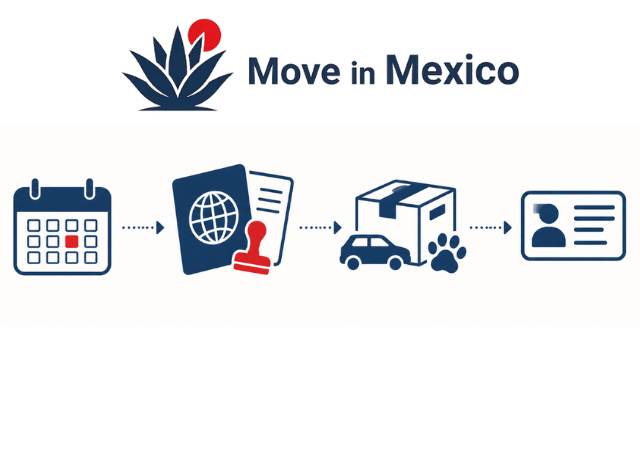
The four phases at a glance
| Phase | When | What it’s about |
|---|---|---|
| 1. Decide & gather | ~6 months before | Pick your city, collect US documents, start apostilles and your financial look-back. |
| 2. Apply | 3–2 months before | Book the consulate appointment, prove economic solvency, get the visa. |
| 3. Move | 1 month before & moving week | Pets, car/TIP, household goods, banking, mail, the border crossing. |
| 4. Settle | First 30 days in Mexico | INM canje, CURP, RFC, bank account, healthcare. |
Print this checklist
The checklist lives on this page as tickable lists — no sign-up, no separate file to lose. When you’re ready, use your browser’s print command (Ctrl+P / Cmd+P) and either print to paper or save it as a PDF so you can check items off as you go. Bookmark it too: several steps only make sense once you’re mid-move.
A caveat we’ll repeat once here: this is general information, not personalized tax or legal advice. Everyone’s income mix, family situation and consulate are different. Where money or law is involved, confirm with the linked guides and, where it matters, a professional.
6 months before: decide, budget and gather documents
Almost everything that goes wrong later is something that should have started here. Give yourself the runway.
- ☐ Confirm Mexico is genuinely the right move for you and pick a target city or region.
- ☐ Check your passport is valid and not near expiry.
- ☐ List the US documents you’ll likely need.
- ☐ Order and start apostilling those documents.
- ☐ Begin your financial look-back paper trail — today, not next month.
Still weighing destinations? It’s fair to compare it with moving to Portugal before you commit — decide once, then execute without second-guessing.
Documents you’ll need
Exact requirements vary by consulate and visa route, but most US applicants end up gathering some combination of:
- ☐ Valid passport (the consulate needs the physical book plus photocopies of the data, last and stamped pages).
- ☐ Birth certificate and, if applying as a family unit, marriage certificate.
- ☐ FBI or state criminal-record check, if requested.
- ☐ Financial evidence: bank and investment statements, and pension or Social Security award letters.
Order the certified copies now. Government offices are slow, and you can’t apostille a document you don’t yet have.
Apostilles: start these first
This is the single most underestimated step. A US document you plan to show a Mexican official almost always needs a US apostille first, and the routing depends on who issued it: federal documents (like an FBI check) go to the US Department of State; state-issued documents (birth and marriage certificates) go to the issuing state’s Secretary of State. Budget roughly four weeks and expect at least one document to come back needing a fix.
Get the routing, timelines and common mistakes right the first time with our walkthrough on how to apostille each U.S. document (federal vs state).
Build your financial look-back trail
The consulate proves your economic solvency by looking backward, so the clock started before you did. There are two common routes, and each has its own window:
- ☐ Income route: steady monthly income across the previous 6 months.
- ☐ Savings route: average monthly balances across the previous 12 months.
If your accounts are scattered or you’re about to make a big transfer, sort that now — a lumpy 12-month history is harder to document than a boring one.
Partners pay Moveinmexico a listing fee or a commission when you sign up. Your price never changes and our recommendations are independent. How we choose partners
Apostilles for your consulate appointment
Monument Visa handles FBI background checks, birth and marriage certificates and pension letters end to end — federal and state apostilles, delivered to your door, inside the validity window Mexican consulates expect.
3–2 months before: apply for your visa at a Mexican consulate
With documents apostilled and finances documented, you apply in person at a Mexican consulate in the US. You cannot start residency inside Mexico as a tourist — the visa is issued abroad.
- ☐ Book the appointment only through MiConsulado.
- ☐ Download and read your consulate’s 2026 economic-solvency sheet.
- ☐ Assemble originals plus photocopies exactly as the sheet lists them.
- ☐ Pay the non-refundable processing fee at the appointment.
- ☐ Do not book flights until the visa is physically granted.
Which financial route fits you
Pick income or savings based on which you can document cleanly, not which number looks smaller. Retirees with strong balances but modest monthly income usually take the savings route; people with steady pensions or salary take the income route. You generally use one or the other, so choose early and build the paper trail to match.
Permanent Resident applicants face higher solvency thresholds than Temporary Resident applicants. We’re deliberately not printing a permanent-residency figure here, because those numbers weren’t verified against a primary consulate sheet in this pass — read them off your own consulate’s Permanent Resident Visa solvency sheet before you rely on them.
Why the number is not the same at every consulate
Here’s the detail no competitor pins down: consulates publish different 2026 solvency figures for the same Temporary Resident Visa. Two real examples:
| Consulate (2026) | Income route (6 months) | Savings route (12 months) | Fee & processing |
|---|---|---|---|
| San Diego | ≥ $4,510 USD/month | ≥ $75,950 USD avg balance | $56 USD; up to ~10 business days |
| Las Vegas | ≥ $4,630 USD/month | ≥ $78,025 USD avg balance | $56 USD; 1–10 business days |
Same visa, different thresholds. The lesson is simple: use the 2026 economic-solvency sheet from the exact consulate where you’ll apply, and never plan around a single “the number is X” claim. The San Diego sheet’s fee is $56 USD, payable in cash at the appointment and non-refundable — if you’re denied, that money is gone.
The consulate appointment, step by step
- ☐ Book only via MiConsulado at citas.sre.gob.mx. There is no legitimate shortcut, and appointments in busy consulates go fast.
- ☐ Bring the physical passport plus photocopies of the data, last and stamped pages.
- ☐ Bring apostilled documents and your financial evidence, arranged to match the sheet.
- ☐ Pay the $56 USD non-refundable fee.
- ☐ If you plan to ship household goods, ask the consulate about the menaje de casa certificate route while you’re already there.
Two warnings straight from the consulates’ own materials. A granted visa lets you request entry at a designated port of entry — it does not guarantee you’ll be admitted. And do not buy plane tickets before the visa is issued; if there’s a delay or denial, you don’t want non-refundable flights riding on it.
1 month before: pets, car, shipping, mail and banking
Visa in hand, this is the logistics month. Pets and cars have the longest lead times, so start with those.
Bringing pets (2026 screwworm rule)
The rules diverged sharply for dogs and cats, so treat them separately.
- ☐ Dogs: as of August 3, 2026, a dog entering Mexico from the US must carry a New World Screwworm (NWS) Inspection Certificate signed by a USDA-accredited veterinarian and issued no more than 5 days before arrival. It does not need APHIS endorsement. Mexico has been treated as screwworm-affected since November 22, 2024.
- ☐ Cats: since December 16, 2019, cats need no health certificate at all and can go to the border without documentation. Don’t list a cat on a dog or bird form — doing so invalidates that form.
- ☐ Both dogs and cats are inspected by SENASICA at entry. Dogs must arrive free of ectoparasites and with no fresh or healing wounds.
This dog rule is new and evolving. Re-check the APHIS page right before you travel in case the form or the 5-day window changes. To line up a vet visit and a pet-relocation partner, compare movers, luggage shipping and mail-forwarding options.
Bringing your car (TIP)
Decide whether the car is coming at all — for many people it’s cheaper to sell and rebuy. If it’s coming:
- ☐ Plan a Temporary Import Permit (TIP) from Banjercito. You can apply online roughly 10–60 days before entry, or get it at the border.
- ☐ Budget the TIP’s administrative fee plus a refundable security deposit. The deposit amount depends on your vehicle’s model year — confirm the current figure on the live Banjercito portal.
- ☐ Buy Mexican auto insurance so it’s active from the day you cross.
- ☐ Note the exception: a TIP is not required inside the Baja California peninsula or the Sonora free zone.
For eligibility, the deposit, insurance and the license question in full, see our guide on getting a Banjercito TIP and Mexican car insurance.
Household goods: ship, drive or replace
Three honest options: drive it down, ship it, or sell it and replace it in Mexico. Cost and sentiment decide it.
- ☐ Get quotes for cross-border movers, and compare against the cost of replacing furniture locally.
- ☐ If you’ll ship, understand the duty-free menaje de casa exemption, which lets you import a household of used goods free of duty once. Vehicles are excluded.
- ☐ Note who the routes are for: the official portal menajedomestico.gob.mx serves returning Mexican nationals, while foreign residents obtain a consular menaje certificate instead. Confirm your eligibility, the exact route and timing with your consulate and Mexican Customs (Aduanas) before you pack a container — don’t assume a deadline.
Banking and mail before you go
Set these up while you still have a US address and easy access to US branches.
- ☐ Sort US or expat-friendly banking, ideally accounts that reimburse ATM fees abroad.
- ☐ Set up a US virtual mailing address / mail-forwarding service so bills, tax mail and cards don’t vanish once you leave.
You can line up movers, luggage shipping and mail forwarding from one place via the logistics hub linked above.
Moving week and the border crossing
The paperwork is done; now you protect it and cross cleanly.
Carry-on document kit
- ☐ Originals and copies of everything the consulate stamped.
- ☐ Keep apostilled originals in your carry-on, never in checked luggage or a shipping container.
- ☐ Passport with the visa, and your financial documents, within reach.
- ☐ If you have a dog, its NWS certificate dated within 5 days of arrival.
At the port of entry
- ☐ Request entry with your residency visa at a designated port of entry.
- ☐ Make sure your entry is stamped and recorded correctly — this is what starts your 30-day clock.
- ☐ If driving: have the TIP and Mexican insurance active from day one, cross in daylight, and plan the route in advance.
Double-check the stamp before you leave the booth. A missing or wrong entry record causes real headaches at your INM appointment.
Your first 30 days in Mexico
You’re in. The most important deadline of the whole move is now running.
The 30-day INM deadline (canje)
You have 30 calendar days from entry to exchange your visa for your residency card at the Instituto Nacional de Migración (INM) — the step called the canje. Miss it and the visa is void; you’d have to start over at a consulate in the US.
- ☐ Book your canje appointment at the INM office for your area as soon as you arrive.
- ☐ Complete the exchange within 30 calendar days — count days, not weeks.
- ☐ Expect the physical card in roughly 15–20 business days after the appointment.
CURP → RFC → bank account
These unlock each other in order, so do them in order.
- ☐ CURP: your 18-character Mexican national ID, generated during INM residency approval. Download your CURP free from the official government site. You need it for almost everything next.
- ☐ RFC: your SAT tax ID. Once you hold the residency card and a CURP, register for your RFC with SAT — book at citas.sat.gob.mx and bring your passport, residency card, CURP and recent proof of address. Tourists can’t get one.
- ☐ Bank account: with a CURP (and usually the residency card and proof of address) you can open a Mexican account.
- ☐ Home base: set up your lease and utilities, and complete the menaje de casa import within its window if you shipped goods.
Healthcare in the first months
There’s usually a coverage gap before you’re eligible for IMSS, Mexico’s public system. Don’t leave it open.
- ☐ Arrange interim private or international health coverage for the early months.
- ☐ Then compare IMSS, private and international insurance for your longer-term plan once you’re settled.
Ongoing: US tax compliance and settling in
The move ends; a couple of obligations don’t.
US taxes don’t stop
US citizens keep filing US taxes from abroad, and you may also acquire Mexican tax-residency and reporting obligations. Get ahead of it before it becomes urgent — start with how your U.S. taxes work once you live abroad, and take personalized questions to a cross-border tax professional.
Driver’s license and renewals
- ☐ Convert to a Mexican driver’s license once you’re a resident.
- ☐ Track your residency card’s validity and renew or convert on schedule — Temporary Resident status is renewable up to four years, after which it converts toward Permanent Resident.
- ☐ Go deeper as needed on the visa, cost-of-living and city guides in the Move in Mexico cluster.
That’s the whole arc — decide, apply, move, settle. Work it top to bottom and the only surprises left are the good kind.
Frequently asked questions
How long does it take to move to Mexico from the US?
Budget 3–9 months end to end. Apostilles take about four weeks, the consulate needs a 6-month (income) or 12-month (savings) financial look-back, and the visa itself is issued in up to ~10 business days after your appointment — then you finish the paperwork in Mexico in your first 30 days.
How much money do I need for a 2026 Temporary Resident Visa?
It depends on your consulate — the figures are not identical everywhere. As of 2026, San Diego lists ~$4,510/month income OR ~$75,950 in average savings, while Las Vegas lists ~$4,630/month OR ~$78,025. Always download the current economic-solvency sheet from the specific consulate where you’ll apply.
Do I need to apostille my US documents?
Yes. US documents presented to Mexican authorities generally need a US apostille first — federal documents through the US Department of State and state documents through the issuing Secretary of State. Start this early; it’s the step people underestimate most.
Can I bring my dog or cat to Mexico?
Cats need no health certificate (rule from Dec 16, 2019). Dogs, as of August 3, 2026, need a screwworm (NWS) inspection certificate from a USDA-accredited vet issued within 5 days of arrival. Both are inspected by SENASICA at the border.
Can I drive my US car into Mexico?
Yes, but beyond the Baja peninsula and the Sonora free zone you need a Temporary Import Permit (TIP) from Banjercito (obtainable online ~10–60 days ahead) plus Mexican auto insurance. The TIP has a fee and a refundable deposit that depends on your car’s model year.
What must I do in my first 30 days in Mexico?
The hard deadline is the INM canje: within 30 calendar days of entry, exchange your visa for your residency card or the visa is void. Then download your CURP, register your RFC at SAT, open a bank account, and complete your menaje de casa import if you shipped goods.
Is there a downloadable checklist?
The full phased checklist is right here on this page as tickable lists. Use your browser’s print command to print it to paper or save it as a PDF, so you can check items off from six months out through your first 30 days in Mexico.
Apostilles for your consulate appointment
Monument Visa handles FBI background checks, birth and marriage certificates and pension letters end to end — federal and state apostilles, delivered to your door, inside the validity window Mexican consulates expect.
Get an Apostille QuoteDisclaimer: general information for U.S. citizens living or planning to live in Mexico — not tax, legal, financial or immigration advice. Financial requirements are indicative 2026 figures: Mexican consulates apply different thresholds, documentation rules and exchange rates, and the UMA they are based on changes every year. Always confirm the requirements with the consulate handling your application, and tax questions with the IRS, SAT or a qualified professional before acting.